It Christmas Time Again Tom Petty Chords
| Folk rock | |
|---|---|
| Stylistic origins |
|
| Cultural origins | Early to mid-1960s, United States |
| Derivative forms |
|
| Subgenres | |
| |
| Other topics | |
| |
Folk stone is a hybrid music genre that combines the elements of folk and rock music, which arose in the United States, Canada, and the Uk in the mid-1960s.[1] [2] In the U.Southward., folk stone emerged from the folk music revival and the influence that the Beatles and other British Invasion bands had on members of that movement. Performers such as Bob Dylan and the Byrds—several of whose members had earlier played in folk ensembles—attempted to blend the sounds of rock with their pre-existing folk repertoire, adopting the employ of electric instrumentation and drums in a fashion previously discouraged in the U.S. folk customs. The term "folk rock" was initially used in the U.S. music printing in June 1965 to describe the Byrds' music.
The commercial success of the Byrds' cover version of Dylan'southward "Mr. Tambourine Man" and their debut album of the aforementioned name, along with Dylan's ain recordings with stone instrumentation—on the albums Bringing It All Back Domicile (1965), Highway 61 Revisited (1965), and Blonde on Blonde (1966)—encouraged other folk acts, such as Simon & Garfunkel, to apply electric bankroll on their records and new groups, such as Buffalo Springfield, to form. Dylan's controversial appearance at the Newport Folk Festival on 25 July 1965, where he was backed by an electric ring, was as well a pivotal moment in the development of the genre.
During the late 1960s in United kingdom of great britain and northern ireland and Europe, a singled-out, eclectic British folk rock mode was created past Pentangle, Fairport Convention and Alan Stivell. Inspired by British psychedelic folk and the North American style of folk rock, British folk rock bands began to contain elements of traditional British folk music into their repertoire, leading to other variants, including the overtly English folk rock of the Albion Band and Celtic stone.
Definition and etymology [edit]
In its primeval and narrowest sense, the term "folk rock" refers to the blending of elements of folk music and rock music, which arose in the U.S. and UK in the mid-1960s.[1] The genre was pioneered by the Byrds, who began playing traditional folk music and songs by Bob Dylan with rock instrumentation, in a style heavily influenced by the Beatles and other British Invasion bands.[3] [4] The term "folk rock" was initially coined past the U.S. music press to describe the Byrds' music in June 1965, the month in which the ring's debut album was issued.[5] [six] Dylan too contributed to the creation of the genre, with his recordings utilizing rock instrumentation on the albums Bringing It All Back Home, Highway 61 Revisited, and Blonde on Blonde.[seven]
In a broader sense, folk rock encompasses similarly inspired musical genres and movements in different regions of the world. Folk rock may lean more towards either folk or rock in instrumentation, playing and vocal mode, and choice of textile. While the original genre draws on music of Europe and North America, there is no clear delineation of which other civilisation's music might be included every bit influences.
Antecedents [edit]
Folk revival [edit]

Pete Seeger entertaining Eleanor Roosevelt (center), at a racially integrated Valentine's Day party.[8]
The American folk-music revival began during the 1940s; edifice on the interest in protest folk singers such as Woody Guthrie and Pete Seeger, it reached a peak in popularity in the mid-1960s with artists such equally Bob Dylan and Joan Baez.[9] [10] In 1948, Seeger formed the Weavers, whose mainstream popularity prepare the stage for the folk revival of the 1950s and early 1960s and too served to bridge the gap between folk, pop music, and topical vocal.[11] The Weavers' sound and repertoire of traditional folk material and topical songs straight inspired the Kingston Trio, a iii-piece folk grouping who came to prominence in 1958 with their hit recording of "Tom Dooley".[11] [12] The Kingston Trio provided the template for a flood of "collegiate folk" groups between 1958 and 1962.[13] [14]

At roughly the same time every bit these "collegiate folk" vocal groups came to national prominence, a 2nd group of urban folk revivalists, influenced past the music and guitar picking styles of folk and blues artist such as Woody Guthrie, Lead Abdomen, Brownie McGhee, and Josh White, besides came to the fore.[fifteen] Many of these urban revivalists were influenced past recordings of traditional American music from the 1920s and 1930s, which had been reissued by Folkways Records; Harry Smith's Album of American Folk Music was particularly influential.[15] [xvi] While this urban folk revival flourished in many cities, New York Urban center, with its burgeoning Greenwich Village coffeehouse scene and population of topical folk singers, was widely regarded as the centre of the move.[xv] [17] Out of this fertile environment came such folk-protest luminaries equally Bob Dylan,[18] Tom Paxton, Phil Ochs, and Peter, Paul and Mary,[19] many of whom would transition into folk rock performers as the 1960s progressed.[15]

Bob Dylan was the almost influential of all the urban folk-protest songwriters.
The vast majority of the urban folk revivalists shared a disdain for the values of mainstream American mass civilization[xx] and led many folk singers to begin composing their own "protest" material.[21] [22] The influence of this folk-protest movement would subsequently manifest itself in the sociopolitical lyrics and mildly anti-establishment sentiments of many folk rock songs, including hitting singles such equally "Eve of Destruction", "Like a Rolling Stone", "For What It's Worth", and "Allow'southward Alive for Today".
During the 1950s and early 1960s in the Britain, a parallel folk revival referred to as the second British folk revival, was led by folk singers Ewan MacColl and Bert Lloyd.[23] Both viewed British folk music as a vehicle for leftist political concepts and an antidote to the American-dominated popular music of the fourth dimension.[23] [24] Nevertheless, information technology wasn't until 1956 and the advent of the skiffle craze that the British folk revival crossed over into the mainstream and connected with British youth culture.[23] [25] Skiffle renewed popularity of folk music forms in Britain and led directly to the progressive folk motion and the attendant British folk gild scene.[23] Among the leading lights of the progressive folk movement were Bert Jansch and John Renbourn, who would afterward form the folk rock band Pentangle in the late 1960s.[26] Other notable folk rock artists with roots in the progressive folk scene were Donovan, Al Stewart, John Martyn and Paul Simon.[27] [28] [ cocky-published source? ]
The Beatles and the British Invasion [edit]
"They were doing things nobody was doing. Their chords were outrageous, just outrageous, and their harmonies made it all valid. You could but do that with other musicians. Even if you're playing your ain chords you had to have other people playing with you. That was obvious. And it started me thinking well-nigh other people."
—Bob Dylan reflecting on how the Beatles influenced his decision to record with an electric bankroll band[29]
Beginning in 1964 and lasting until roughly 1966, a wave of British beat groups, including the Beatles, the Rolling Stones, the Dave Clark V, Gerry & the Pacemakers, the Kinks, and Herman's Hermits amongst others, dominated the U.Southward. music charts.[30] [31] These groups were all heavily influenced past American rock 'n' roll, dejection, and R&B—musical genres they had been introduced to via homegrown British rock 'n' roll singers, imported American records, and the music of the skiffle craze.[xxx] [32] These United kingdom groups, known collectively as the British Invasion, reintroduced American youth culture to the broad potential of rock and popular music every bit a creative medium and to the wealth of musical civilisation to be found within the United States.
Of particular importance to the evolution of folk rock by the British Invasion were the subtle folk influences evident in such Beatles' compositions every bit "I'll Exist Back", "Things Nosotros Said Today", and "I'm a Loser",[33] with the latter song beingness directly inspired by folk singer-songwriter Bob Dylan.[34] In the opinion of Roger McGuinn of the Byrds, writers who attempt to define the origins of folk rock "don't realise that the Beatles were responsible as far dorsum as 1963". He cites "She Loves You" as 1 of the outset examples where the Beatles introduced folk chord changes into rock music and and so initiated the new genre.[35] These songs were all influential in providing a template for successfully assimilating folk-based chord progressions and melodies into pop music. This melding of folk and rock 'due north' roll in the Beatles' music became even more explicit during 1965, with the release of "You lot've Got to Hibernate Your Beloved Away", a folk-derived song with introspective lyrics, again influenced by Dylan.[36] [37] Although the Beatles themselves utilized folk as just i of many styles evident in their music, the underlying folk influences in a number of their songs would prove to be important to folk stone musicians attempting to blend their own folk influences with vanquish music.
The effect that the music of these British bands, and the Beatles in particular, had on young Americans was immediate; almost overnight, folk—forth with many other forms of homegrown music—became passé for a large proportion of America'southward youth, who instead turned their attention to the influx of British acts.[32] [38] The influence of these acts also impacted on the collegiate folk and urban folk communities, with many young musicians quickly losing involvement in folk music and instead embracing the rock 'n' roll derived repertoire of the British Invasion.[38] Future members of many folk rock acts, including the Byrds, Jefferson Airplane, the Lovin' Spoonful, the Mamas & the Papas, and Buffalo Springfield, all turned their backs on traditional folk music during 1964 and 1965 as a direct result of the influence of the Beatles and the other British Invasion bands. Author and music historian Richie Unterberger has noted that the Beatles' impact on American popular culture effectively sounded the death knell for the American folk music revival.[38]
In improver to The Beatles, the two British groups that were arguably the most influential on the development of folk rock were the Animals and the Searchers. The Animals released a rock interpretation of the traditional folk song "The Firm of the Rising Sun" in the U.Southward. in August 1964. The song reached number one on the Billboard Hot 100 singles nautical chart and stayed there for three weeks, selling over a million copies in simply 5 weeks in the U.Southward.[39] The band'due south arrangement of "The Firm of the Ascension Sun", which transmuted the vocal from an audio-visual folk complaining to a total-bore electric rock vocal, would go on to influence many folk stone acts simply none more and so than Dylan himself, who cited it equally a fundamental factor in his decision to record and perform with an electric stone band in 1965.[forty]
Electric Twelve-String Guitar in Folk Music [edit]
The Searchers were influential in popularizing the jangly audio of the electrical twelve-cord guitar.[41] [42] Many musicians in the collegiate and urban folk movements were already familiar with acoustic twelve-string guitars via the music of folk and dejection singer Atomic number 82 Belly. However, the Searchers' use of amplified twelve-strings provided some other example of how conventional folk elements could be incorporated into rock music to produce new and exciting sounds. The Beatles' lead guitarist, George Harrison, also influenced this trend towards jangly guitars in folk rock with his utilise of a Rickenbacker twelve-string guitar on the Beatles' mid-1960s recordings. This relatively clean, jangly sound—without baloney or other guitar effects—became a cornerstone of folk rock instrumentation and was used in many American folk stone records made during 1965 and 1966.[ citation needed ]
Other precursors [edit]
"We were a group, but not professional musicians. I had to de-complicate my music and get it simpler and simpler, and so that we could play it and brand it sound like a pop thing. Whenever yous have a format like that, it sounds folky, considering it'south non glitzed over with annihilation. We only had acoustic and electric guitars, then every adventure we got, we'd attempt to add some multifariousness. The only way you could get diversity was to go to a harmonica during this song, or get an acoustic in this space; become different moods that way."
—Ron Elliott of The Beau Brummels on the origins of the band's folk-flavored sound
Although folk rock mainly grew out of a mix of American folk revival and British Invasion influences,[9] in that location were likewise a few examples of proto-folk rock that were of import in the development of the genre. Of these secondary influences, Unterberger has cited the self-penned, folk-influenced material of San Francisco's the Beau Brummels as arguably the near important. Despite their Beatlesque image, the band's utilise of small chords, haunting harmonies, and folky acoustic guitar playing—equally heard on their debut unmarried "Laugh, Laugh"—was stylistically very like to the later on folk rock of the Byrds.[43] [nb 1] Released in December 1964, "Express joy, Laugh" peaked at number xv on the Billboard Hot 100 in early 1965, while its similarly folk-flavored follow-upwards, "Merely a Little", did fifty-fifty better, reaching number 8 on the U.S. singles chart.[43] [44] [45] The high-contour success of the Swain Brummels' music was important in demonstrating that a hybrid of folk and stone could potentially exist translated into mainstream commercial success.[43]
Pre-dating the Swain Brummels' commercial quantum past almost 2 years, singer-songwriter Jackie DeShannon's April 1963 single "Needles and Pins" marked, according to Unterberger, the earliest appearance of the ringing guitar sound that would become a mainstay of early folk rock.[33] This use of cyclical, chiming guitar riffs was repeated on DeShannon'southward late 1963 recording of her own composition "When Yous Walk in the Room".[33] The following year, both songs would become hits for the Liverpudlian ring the Searchers, who chose to place even greater emphasis on the jangly guitar playing in the songs.[33] In improver, a number of DeShannon'south songs from the period, including "When You Walk in the Room", displayed a greater caste of lyrical maturity and sensuality than was usual for popular songs of the fourth dimension.[33] This heightened caste of emotional introspection was inspired by her love of Bob Dylan's folk songwriting and represents one of the beginning attempts past an American creative person to absorb folk sensibilities into rock music.[33]
In the UK, the folk grouping the Springfields (featuring Dusty Springfield) had been releasing folk-oriented material featuring full band arrangements since the early on 1960s, including renditions of "Lonesome Traveler", "Allentown Jail", and "Argent Threads and Golden Needles".[46] Although these records owed more to orchestral pop than rock, they were nonetheless influential on upwards-and-coming folk rock musicians on both sides of the Atlantic.[46] In mid-1965, folk singer-songwriter Donovan was also experimenting with adding electrified instrumentation to some of his folk and blues-styled material, every bit evidenced by songs such as "You're Gonna Demand Somebody on Your Bond" and "Sunny Goodge Street".[47] In spite of his folky persona and repertoire, Donovan himself had ever considered himself a pop star, rather than a folk singer.[48] Every bit a result, he had been thinking of a way in which to introduce folk styled acoustic guitars and socially conscious lyrics into popular music for several years prior to his 1965 breakthrough every bit a recording creative person.[48] By January 1966, he had recorded the self-penned striking "Sunshine Superman" with a total electric backing band.[49] [50]
Other bands and solo artists who were blurring the boundaries between folk and rock in the early 1960s include Judy Henske,[51] Richard and Mimi Fariña,[52] and the Mugwumps, the latter of which were a New York band featuring future members of the Lovin' Spoonful and the Mamas & the Papas.[53] Also of note are the Australian band the Seekers, who had relocated to England in 1964 and reached number i on the UK Singles Chart with "I'll Never Detect Some other You lot" in February 1965.[54] [55] Unterberger has noted that, although it was not strictly a folk song, "I'll Never Find Another Y'all" was heavily influenced by Peter, Paul and Mary and featured a cyclical, twelve-string guitar office that sounded similar to the guitar style that Jim McGuinn of the Byrds would popularize later that same year.[48] [56]
At that place are too a few antecedents to folk rock present in pre-British Invasion American rock 'north' coil, including Elvis Presley'due south 1954 encompass of the Neb Monroe bluegrass standard "Blue Moon of Kentucky";[57] Buddy Holly's self-penned material, which strongly influenced both Dylan and the Byrds;[57] [58] Ritchie Valens' recording of the Mexican folk song "La Bamba";[57] Lloyd Cost's stone 'northward' curl adaptation of the African-American folk song "Stagger Lee" (originally recorded past Mississippi John Hurt in 1928);[57] [59] Jimmie Rodgers' rock 'n' coil flavored renditions of traditional folk songs;[60] and the folk and land-influenced recordings featured on the Everly Brothers' 1959 anthology Songs Our Daddy Taught Us.[57]
1960s [edit]
The Byrds [edit]
The moment when all of the separate influences that served to make upwards folk rock finally coalesced into an identifiable whole was with the release of the Byrds' recording of Bob Dylan's "Mr. Tambourine Human being".[7] [61] [62] [63] The term "folk rock" was coined past the U.S. music press to describe the ring's sound in June 1965, at roughly the aforementioned time every bit "Mr. Tambourine Man" peaked at number 1 on the Billboard chart.[five] [6] [64] Within iii months it had get the get-go folk stone blast hit,[65] reaching number 1 on both the Billboard Hot 100 and the UK Singles Chart.[66] [67] The single'due south success initiated the folk rock boom of 1965 and 1966, during which a profusion of Byrds-influenced acts flooded the American and British charts.[7] [61] [nb 2] In particular, the Byrds' influence can be discerned in mid-1960s recordings by acts such as the Lovin' Spoonful, Barry McGuire, the Mamas & the Papas,[64] Simon & Garfunkel,[76] Jefferson Airplane, the Turtles, We Five, Love, and Sonny & Cher.[vii] [61] [77] [78] [79] [ text–source integrity? ]
It was during the rehearsals at World Pacific that the ring began to develop the blend of folk music and Beatles-style pop that would characterize their sound.[lxxx] However, this hybrid was non deliberately created; it evolved organically out of some of the band members' ain folk music roots and their desire to emulate the Beatles.[73] The band's folk influences, lack of feel with rock music forms, and Beatleseque instrumentation all combined to color both their self-penned material and their folk derived repertoire.[7] [73] [81] The ring themselves shortly realized that there was something unique about their music and, with Dickson's encouragement, they began to actively endeavour to bridge the gap between folk and rock.[73] [82]
Mr. Tambourine Man's blend of abstruse lyrics, folk-influenced tune, circuitous harmonies, jangly 12-string Rickenbacker guitar playing, and Beatles-influenced vanquish, resulted in a synthesis that effectively created the subgenre of folk rock.[69] [83] The song'southward lyrics lone took stone and pop songwriting to new heights; never before had such intellectual and literary lyrics been combined with rock instrumentation by a popular music group.[84]
Dylan'southward cloth would provide much of the original grist for the folk stone factory, non only in the U.S. only in the UK likewise, with many pop and rock acts covering his textile in a style reminiscent of the Byrds.[61] Their reworking of "Mr. Tambourine Homo", along with the Animals' rock interpretation of "The Firm of the Rising Sun" (itself based on Dylan's earlier cover), helped to requite Dylan the impetus to get-go recording with an electric bankroll band.[85]
As the 1970s dawned, folk rock evolved away from the jangly template pioneered by the Byrds, but their influence could still exist heard in the music of bands similar Fairport Convention and Pentangle.[3] [7] [86] The Byrds themselves continued to enjoy commercial success with their make of folk stone throughout 1965, most notably with their number ane unmarried "Turn! Turn! Turn!".[64] By the start of 1966, notwithstanding, the group had begun to move away from folk rock and into the new musical frontier of psychedelic rock. The folk rock sound of the Byrds has connected to influence many bands over the years, including Big Star, Tom Piddling and the Heartbreakers, R.E.One thousand., the Long Ryders, the Smiths, the Bangles, the Stone Roses, and Teenage Fanclub, amongst others.[87]
Bob Dylan [edit]

Five days before the Byrds entered Columbia Studios in Hollywood to record his song "Mr. Tambourine Man", Bob Dylan completed the recording sessions for his 5th anthology, Bringing It All Back Habitation.[88] Of the xi tracks on the album, seven featured Dylan backed by a full electric rock band, in stark contrast to his earlier audio-visual folk albums.[88] Dylan's determination to record with an electric backing ring had been influenced by a number of factors, including the Beatles' coupling of folk derived chord progressions and beat music, the Byrds' rock adaptation of "Mr. Tambourine Man", and the Animals striking encompass of "The Business firm of the Rising Sun".[twoscore] [89]
Bringing It All Back Habitation was released on 22 March 1965,[ninety] peaking at number 6 on the Billboard Summit LPs chart and #1 on the Great britain Album Chart.[91] [92] The album's blend of rhythm and blues-derived rock and abstract, poetic lyrics was immediately influential in demonstrating that intelligent lyrical content could exist wedded with rock 'n' roll.[93] The songs on the album saw Dylan leaving folk music far behind.[94] Even with this folkier, acoustic fabric, Dylan'southward biting, apocalyptical, and oft humorous lyrics went far beyond those of contemporary folk music,[94] peculiarly the folk-protest music with which he had been previously associated.
On 20 July 1965, Dylan released the groundbreaking "Like a Rolling Stone", a vi-minute-long scathing put-down, directed at a downward-and-out society girl, which over again featured Dylan backed by an electric rock band.[95] [96] Released just as the Byrds' comprehend of "Mr. Tambourine Homo" topped the charts in the United states of america, the song was instrumental in defining the burgeoning folk stone scene and in establishing Dylan as a bona fide rock star, rather than a folksinger.[95] "Like a Rolling Stone" managed to reach the Height 5 on both sides of the Atlantic.[92] [97] Five days after the release of "Similar a Rolling Stone", on 25 July 1965, Dylan fabricated a controversial advent at the Newport Folk Festival, performing three songs with a full band.[95] He was met with derisive booing and jeering from the festival's purist folk music crowd,[98] but in the years since the incident, Dylan's 1965 Newport Folk Festival appearance has become widely regarded as a pivotal moment in the synthesis of folk and rock.[95] [99] [100]
Dylan followed "Like a Rolling Stone" with the wholly electric album Highway 61 Revisited and the non-album single "Positively quaternary Street", which itself has been widely interpreted as a rebuke to the folk purists who had rejected his new electric music. Throughout 1965 and 1966, striking singles similar "Subterranean Homesick Blues", "Like a Rolling Stone", "Positively 4th Street", and "I Want You" among others, along with the Bringing It All Back Home, Highway 61 Revisited and Blonde on Blonde albums, proved to exist hugely influential on the evolution and popularity of folk rock.[101] Although Dylan'south move away from audio-visual folk music served to outrage and alienate much of his original fanbase, his new folk stone audio gained him legions of new fans during the mid-1960s. The popularity and commercial success of the Byrds and Bob Dylan's blend of folk and stone music influenced a wave of imitators and emulators that retroactively became known as the folk stone smash.[vii]
Tom Wilson [edit]
Although he started out equally a jazz musician, the young, African-American Columbia Records producer Tom Wilson became known as the "mid-married woman of folk-rock" for his seminal work behind the scenes. As Bob Dylan's producer during the cardinal transitional albums The Times They Are A-Changin, Another Side of Bob Dylan, and Bringing It All Back Home, he was a key architect of Dylan'due south electric sound. He is perhaps even improve known, however, for offset discovering Simon & Garfunkel at the tail cease of the folk movement then transforming them into folk-rock superstars with the unauthorized rock remix that made a number one hit out of their previously underappreciated song, "The Sound of Silence".[102] [103]
Other musicians [edit]
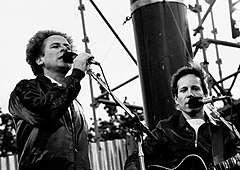
Folk rock musicians Simon & Garfunkel performing in Dublin
Music critic Richie Unterberger has noted that the commercial success of the Byrds' comprehend version of Dylan'south "Mr. Tambourine Man", along with Dylan's ain contributions to the genre on the albums Bringing Information technology All Back Home, Highway 61 Revisited, and Blonde on Blonde, initiated an explosion of emulators and imitators.[vii] [61] Their success led tape producer Tom Wilson to add electric guitar, bass, and drums overdubs to "The Sounds of Silence", a song which had been recorded by the folk duo Simon & Garfunkel in 1964 and kickoff released on their album Wed Morning time, 3 A.M.. The reissued single rose to number i on the Billboard pop chart in late 1965, became a hit effectually the world, and set the duo on ane of the most successful careers in pop and rock music.[76] Simon and Garfunkel accept been described equally "folk-rock's greatest duo, and ane whose fame and influence would persist well beyond folk-rock's heyday."[104]
I of the kickoff bands to craft a distinctly American sound in response to the British Invasion was the Embankment Boys; while not a folk rock ring themselves, they directly influenced the genre and at the height of the folk rock smash in 1966 had a hit with a cover of the 1920s Westward Indian folk vocal "Sloop John B", which they had learned from the Kingston Trio, who had learned it from the Weavers.[105]
Much of the early folk-rock music emerged during a time of general global upheaval, the Vietnam War, and new concerns for the world by young people. In the United states, the heyday of folk rock was arguably between the mid-sixties and the mid-seventies, when it aligned itself with the hippie movement and became an of import medium for expressing radical ideas. Cities such as San Francisco, Denver, New York City and Phoenix became centers for the folk rock culture, playing on their cardinal locations among the original folk circuits. The "unplugged" and simplified sound of the music reflected the genre's connection to a critical view of a technological and consumerist club. Unlike popular music's escapist lyrics, arguably a fantasy distraction from the issues in life, folk artists attempted to communicate concerns for peace, global sensation, and other touchstones of the era. Bands whose music was significantly folk rock in sound during the mid-to-tardily 1960s included Donovan,[106] the Lovin' Spoonful, the Mamas & the Papas,[64] the Youngbloods, Love, and, in their early years, Jefferson Airplane.
In the mid-1960s, vocalist-songwriter Gordon Lightfoot began moving his folk songs into a folk-stone management with recordings such every bit the percussion-driven "Blackness Day in July" almost the 1967 Detroit anarchism. He would rise to top the charts in the 1970s with a number of his folk-stone recordings such as "Sundown" and "Carefree Highway" and somewhen become known as a folk-rock legend.[107] Some artists who originally produced with a harder edged rock sound institute the ability to communicate more easily and felt more genuine in this method of delivery. In this category was Cat Stevens, who began in London much like the Byrds did in the United states of america but toned down the sound more than often with acoustic instruments. He performed songs that contained concern for the surroundings, war, and the future of the earth in general. The Canadian singer-songwriter Joni Mitchell won many Grammy Awards with her folk rock/pop songs.
[edit]
British folk rock [edit]

British folk rock adult in Uk during the mid to tardily 1960s by the bands Fairport Convention, and Pentangle.[108] [109] It uses traditional British music and self-penned compositions in a traditional style, and is played on a combination of traditional and stone instruments.[110] This incorporation of traditional British folk music influences gives British folk rock its distinctly British character and season.[108] It evolved out of the psychedelia-influenced folk rock of British acts such as Donovan, the Incredible String Ring, and Tyrannosaurus King, but was also heavily influenced by such American folk rock bands every bit the Byrds, Love, and Buffalo Springfield.[109] British folk rock was at its most pregnant and popular during the belatedly 1960s and 1970s, when, in addition to Fairport and Pentangle, it was taken upward by groups such as Steeleye Span and the Albion Band.[26] [111]
Steeleye Span, founded by Fairport Convention bass histrion Ashley Hutchings, was made up of traditionalist folk musicians who wished to incorporate electric amplification, and later overt stone elements, into their music.[112] This, in plough, spawned the conspicuously English folk rock music of the Albion Band, a group that likewise included Hutchings.[113] In Brittany folk stone was developed by Alan Stivell (who began to mix his Breton, Irish gaelic, and Scottish roots with stone music) and later by French bands similar Malicorne.[114] [115] During this same catamenia, folk rock was adopted and developed in the surrounding Celtic cultures of Republic of ireland, Scotland, Wales, Brittany, and Cornwall, to produce Celtic rock and its derivatives.[116] [115]
Country folk [edit]
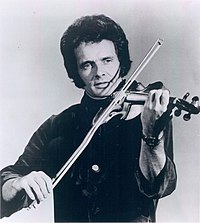
Merle Haggard and others influenced the sound of artists such equally Bob Dylan, Ian and Sylvia, and the Byrds who adopted the sound of land music in the late 1960s.
A subgenre originally arising from the early 1960s folk and country-influenced music of vocalist-songwriter artists such equally Bob Dylan and Bobby Bare, besides every bit from folk revivalist vocal groups like the Kingston Trio.[117] [118] [119] During the tardily 1960s, many folk stone artists including Dylan, Ian and Sylvia, and the Byrds began to contain a potent state influence into their music, drawing heavily on Hank Williams, Merle Haggard, and Buck Owens amid others, resulting in the concurrent adjunct of state rock.[120] [121] This successful blending of country, folk and stone styles led to pioneering country folk records by folk-influenced vocalizer-songwriters such as John Denver and Neil Young during the 1970s.[122] Land folk music unremarkably displays a softer, more "laid-dorsum" experience than the majority of country music and is often complemented past introspective lyrics, thus preserving its folk vocaliser-songwriter roots.[117] Since the 1970s, the country folk subgenre has been perpetuated by artists including John Prine, Nanci Griffith, Kathy Mattea, Mary Chapin Carpenter, and Iris DeMent.[123] [124]
Celtic rock [edit]
A subgenre of folk rock that combines traditional Celtic instrumentation with rock rhythms, often influenced by a wide variety of pop and rock music styles.[125] It emerged from the electric folk music of the late 1960s and was pioneered by bands such as Horslips, who blended Gaelic mythology, traditional Irish gaelic music and rock.[116] The British singer-songwriter Donovan was also influential in developing Celtic rock during the tardily 1960s, with his albums The Hurdy Gurdy Man, Barabajagal, and Open Road, the latter of which really featured a vocal entitled "Celtic Stone".[126] [127]
The subgenre was further popularised in 1973 by Thin Lizzy, who had a hit with "Whiskey in the Jar", a traditional Irish vocal performed entirely in the rock idiom.[116] [128] Throughout the 1970s, Celtic rock held shut to its folk roots, drawing heavily on traditional Celtic dabble, pipage, and harp tunes, as well as traditional song styles, but making apply of stone ring levels of amplification and percussion.[116] [129] In the 1980s and beyond, Celtic rock was perpetuated by bands such as the Pogues, the Waterboys, Runrig, Black 47, and the Prodigals. A more recent folk rock ring based in England is the BibleCode Sundays.[125] [130] Celtic rock is besides popular in Spain where bands such every bit Celtas Cortos take had a large following since the early on 1990s.
Medieval folk rock [edit]

Medieval folk rock developed every bit a subgenre of electric folk from about 1970 as performers, particularly in England, Federal republic of germany and Brittany, adopted medieval and renaissance music as a basis for their music, in contrast to the early modern and nineteenth century ballads that dominated the output of Fairport Convention. This followed the trend explored by Steeleye Span, and exemplified past their 1972 album Below the Table salt. Acts in this area included Gryphon, Gentle Giant and Third Ear Ring.[131] In Federal republic of germany Ougenweide, originally formed in 1970 every bit an acoustic folk group, opted to draw exclusively on High German medieval music when they electrified, setting the agenda for time to come German electrical folk.[132] In Brittany, equally role of the Celtic rock movement, medieval music was focused on by bands similar Ripaille from 1977 and Saga de Ragnar Lodbrock from 1979.[133] Even so, past the terminate of the 1970s almost all of these performers had either disbanded or moved, like Gentle Behemothic and Gryphon, into the developing area of progressive rock.[134] [ self-published source? ] In the 1990s, as function of the wider resurgence of folk music in general, new medieval folk rock acts began to appear, including the Ritchie Blackmore project Blackmore'due south Night, German bands such as In Extremo, Subway to Sally or Schandmaul and English bands like Circulus.[135]
Progressive folk rock [edit]
In Britain the tendency to electrify brought several progressive folk acts into stone.[136] This includes the acoustic duo Tyrannosaurus Rex, who became the electric philharmonic T. King.[137] Others, probably influenced by the electric folk pioneered by Fairport Convention from 1969, moved towards more traditional cloth, a category including Dando Shaft, Amazing Blondel, and Jack the Lad, an offshoot of northern progressive folk group Lindisfarne, who were one of the well-nigh successful UK bands of the early on 1970s.[138] Examples of bands that remained firmly on the border betwixt progressive folk and progressive rock were the brusk lived (but afterwards reunited) Comus and, more successfully, Renaissance, who combined folk and rock with elements of classical music.[139]
Folk metallic [edit]
Folk metallic is a fusion genre of heavy metallic music and traditional folk music that developed in Europe during the 1990s. It is characterised by the widespread use of folk instruments and, to a lesser extent, traditional singing styles (for case, Dutch Heidevolk, Danish Sylvatica and Castilian Rock of Erech). It also sometimes features soft instrumentation influenced past folk rock.
The earliest folk metal bands were Skyclad from England, Cruachan from Ireland and Mago de Oz from Spain. Skyclad's debut album The Wayward Sons of Mother Earth was released in 1991 and would exist considered a thrash metal album with some folk influences, unlike Cruachan's early work which embraced the folk element as a defining part of their sound. It was non until 1994 and 1995 that other early contributors in the genre began to emerge from different regions of Europe and beyond. Among these early groups, the German band Subway to Sally spearheaded a different regional variation that over time became known as medieval metallic. Despite their contributions, folk metal remained piddling known with few representatives during the 1990s. It was not until the early 2000s when the genre exploded into prominence, particularly in Finland with the efforts of such groups as Finntroll, Ensiferum, Korpiklaani, Turisas, and Moonsorrow.
The music of folk metal is characterised by its diversity with bands known to perform dissimilar styles of both heavy metal music and folk music. A big variety of folk instruments are used in the genre with many bands consequently featuring six or more than members in their regular line-ups. A few bands are too known to rely on keyboards to simulate the sound of folk instruments. Lyrics in the genre commonly deal with fantasy, mythology, paganism, history and nature.
Run across too [edit]
- Listing of folk rock artists
- Rockabilly
- Bluegrass music
- Folk metal
- Heathen rock
Notes [edit]
- ^ Neither the band nor their guitarist and chief songwriter Ron Elliott were overtly influenced by folk music.[43] Elliot's own musical leanings were more towards country and western and musical theatre, with any folk influence in the band's music appearing to have been entirely unintentional.[43]
- ^ The nucleus of the Byrds formed in early 1964, when Jim McGuinn, Gene Clark, and David Crosby—united by a shared dear of the Beatles' music—came together under the moniker of the Jet Set up at The Troubadour folk club in Los Angeles.[68] The trio all had a background in folk music, with each member having worked as a folk vocaliser on the acoustic coffeehouse circuit during the early 1960s.[69] They had also spent fourth dimension, independently of each other, in various folk groups, including the New Christy Minstrels, the Limeliters, the Chad Mitchell Trio, and Les Baxter's Balladeers.[seventy] [71] [72] Soon after forming the Jet Set, Crosby introduced McGuinn and Clark to his associate Jim Dickson, who became the group's director.[73] Dickson had access to World Pacific Studios in Los Angeles, which he began to utilize as a rehearsal space for the band.[74] During the form of 1964, the trio expanded their ranks to include drummer Michael Clarke and bassist Chris Hillman, with the band somewhen changing its proper name to the Byrds in November.[75]
References [edit]
- ^ a b "Folk-Rock Entry". Encyclopædia Britannica . Retrieved 15 March 2010.
- ^ Richie Unterberger (twenty February 2014). Jingle Jangle Forenoon: Folk-Rock in the 1960s. BookBaby. pp. xviii–nineteen. ISBN9780991589210.
- ^ a b "Folk-Rock Overview". AllMusic . Retrieved fifteen March 2010.
- ^ Gendron, Bernard. (2002). Between Montmartre and the Mudd Guild: Pop Music and the Avant-Garde. University of Chicago Press. p. 180. ISBN0-226-28737-8.
- ^ a b Unterberger, Richie. (2002). Plough! Turn! Turn!: The '60s Folk-Rock Revolution. Backbeat Books. p. 133. ISBN0-87930-703-X.
- ^ a b Rogan, Johnny. (1998). The Byrds: Timeless Flying Revisited (2nd ed.). Rogan House. p. 83. ISBN0-9529540-i-X.
- ^ a b c d e f one thousand h "Folk Rock: An Overview". Richieunterberger.com. Retrieved fifteen March 2010.
- ^ Photograph by Joseph Horne for the Part of State of war Information, 1944. From the Washington Post, 12 February 1944: "The Labor Canteen, sponsored by the United Federal Workers of America, CIO, will be opened at viii p.m. tomorrow at 1212 18th st. nw. Mrs. Roosevelt is expected to attend at 8:30 p.chiliad."
- ^ a b "1962–66: American Folk-Rock vs. The British Invasion" (PDF). State Academy of New York at Oswego. Archived from the original (PDF) on 11 June 2011. Retrieved 19 March 2010.
- ^ Graeme Smith (January 1997). "'Wasn't That a Fourth dimension!' Firsthand Accounts of the Folk Music Revival. Edited by Ronald D. Cohen. Metuchen, North.J. and London: The Scarecrow Press, 1995. 232 pp.Ethnomimesis. Folklife and the Representation of Civilization. By Robert Cantwell. Chapel Hill and London: The University of North Carolina Printing, 1993. 323 pp.Thirty Years of the Cambridge Folk Festival. Compiled and Edited by Dave Laing and Richard Newman. Ely: Music Maker Books, 1994. 162 pp". Pop Music. Cambridge Academy Press. 16 (1): 127. doi:10.1017/s0261143000000787.
- ^ a b "The Weavers Biography". AllMusic . Retrieved 20 March 2010.
- ^ The Kingston Trio Billboard Singles at AllMusic. Retrieved 21 March 2010.
- ^ Weissman, Dick. (2006). Which Side Are You On?: An Inside History of the Folk Music Revival in America. Continuum International Publishing Group. pp. 74–78. ISBN0-8264-1914-3.
- ^ Mitchell, Gillian. (2007). The North American Folk Music Revival: Nation and Identity in the United States and Canada, 1945–1980. Ashgate Publishing. pp. 70–71. ISBN978-0-7546-5756-9.
- ^ a b c d Unterberger, Richie. (1999). The Crude Guide to Music USA. Rough Guides. pp. 22–23. ISBN1-85828-421-X.
- ^ Weissman, Dick. (2006). Which Side Are You On?: An Inside History of the Folk Music Revival in America. Continuum International Publishing Group. pp. 86–88. ISBN0-8264-1914-3.
- ^ Weissman, Dick. (2006). Which Side Are You On?: An Inside History of the Folk Music Revival in America. Continuum International Publishing Group. pp. 91–95. ISBN0-8264-1914-three.
- ^ Gilliland 1969, testify 31.
- ^ Gilliland 1969, show 19.
- ^ Weissman, Dick. (2006). Which Side Are Y'all On?: An Inside History of the Folk Music Revival in America. Continuum International Publishing Group. p. 97. ISBN0-8264-1914-3.
- ^ Unterberger, Richie. (2002). Turn! Turn! Plow!: The '60s Folk-Rock Revolution. Backbeat Books. pp. 32–33. ISBN0-87930-703-X.
- ^ Weissman, Dick. (2006). Which Side Are You On?: An Within History of the Folk Music Revival in America. Continuum International Publishing Group. p. 159. ISBN0-8264-1914-3.
- ^ a b c d Sweers, Britta. (2005). Electrical Folk: The Changing Face of English language Traditional Music. Oxford University Press. pp. 31–39. ISBN0-19-515878-4.
- ^ Brocken, Michael. (2003). The British Folk Revival 1944–2002. Ashgate Publishing Limited. pp. 25–39. ISBN0-7546-3282-2.
- ^ Brocken, Michael. (2003). The British Folk Revival 1944–2002. Ashgate Publishing Limited. pp. 67–77. ISBN0-7546-3282-2.
- ^ a b Sweers, Britta. (2005). Electric Folk: The Changing Face up of English language Traditional Music. Oxford Academy Press. pp. 81–85. ISBN0-19-515878-4.
- ^ Brocken, Michael. (2003). The British Folk Revival 1944–2002. Ashgate Publishing Limited. p. 84. ISBN0-7546-3282-2.
- ^ Barry, Lee. (2006). John Martyn: Grace & Danger. Lulu.com. pp. 18–22. ISBNane-84728-988-half-dozen. [ self-published source ]
- ^ Scaduto, Anthony. (1971). Bob Dylan: An Intimate Biography. Grosset & Dunlap. p. 175.
- ^ a b "British Invasion Overview". AllMusic . Retrieved 9 April 2010.
- ^ Inglis, Ian. (2000). The Beatles, Pop Music and Society: A Thousand Voices. Palgrave Macmillan. p. 53. ISBN0-312-22236-X.
- ^ a b "British Invasion Essay". AllMusic . Retrieved 10 Apr 2010.
- ^ a b c d eastward f Unterberger, Richie. (2002). Turn! Turn! Turn!: The '60s Folk-Stone Revolution. Backbeat Books. pp. 88–ninety. ISBN0-87930-703-X.
- ^ MacDonald, Ian. (1995). Revolution in the Head. Pimlico. pp. 97–98. ISBN0-7126-6208-1.
- ^ Alexander, Phil; et al. (July 2006). "The 101 Greatest Beatles Songs". Mojo. pp. 92–93.
- ^ Frith, Simon; Straw, Will; Street, John (2001). The Cambridge Companion to Popular and Rock . Cambridge Companions to Music. Cambridge University Press. p. 119. ISBN0-521-55660-0.
- ^ MacDonald, Ian. (1995). Revolution in the Head. Pimlico. p. 118. ISBN0-7126-6208-1.
- ^ a b c Unterberger, Richie. (2002). Turn! Turn! Plow!: The '60s Folk-Rock Revolution. Backbeat Books. pp. 63–66. ISBN0-87930-703-X.
- ^ "House of the Rising Sun – The History and the Song". BBC. Retrieved two May 2010.
- ^ a b Unterberger, Richie. (2002). Turn! Turn! Turn!: The '60s Folk-Rock Revolution. Backbeat Books. pp. 93–96. ISBN0-87930-703-X.
- ^ Brinn, David (30 July 2016). "The Searchers However on 'Needles and Pins'". The Jerusalem Post . Retrieved 26 February 2018.
- ^ Scott Schinder (xxx Dec 2007). Icons of Rock. ABC-CLIO. p. 160. ISBN9780313338458.
- ^ a b c d east f Unterberger, Richie. (2002). Turn! Plough! Turn!: The '60s Folk-Stone Revolution. Backbeat Books. pp. 125–126. ISBN0-87930-703-X.
- ^ "Laugh, Laugh song review". AllMusic . Retrieved 10 May 2010.
- ^ Whitburn, Joel. (2008). Tiptop Popular Singles 1955–2006. Record Enquiry Inc. p. 69. ISBN978-0-89820-172-vii.
- ^ a b Unterberger, Richie. (2002). Turn! Turn! Plough!: The '60s Folk-Rock Revolution. Backbeat Books. p. 59. ISBN0-87930-703-X.
- ^ Unterberger, Richie. (2002). Turn! Turn! Turn!: The '60s Folk-Rock Revolution. Backbeat Books. p. 232. ISBN0-87930-703-X.
- ^ a b c Unterberger, Richie. (2002). Plough! Plough! Turn!: The '60s Folk-Stone Revolution. Backbeat Books. p. 130. ISBN0-87930-703-X.
- ^ "Donovan Sessionography". Open Road: The Donovan Home Page. Retrieved eleven May 2010.
- ^ Leitch, Donovan. (2005). The Autobiography of Donovan: The Hurdy Gurdy Human being. Century Books. p. 139. ISBNi-84413-882-eight.
- ^ "Judy Henske Biography". AllMusic . Retrieved 11 May 2010.
- ^ Unterberger, Richie. (2002). Turn! Plow! Plough!: The '60s Folk-Stone Revolution. Backbeat Books. pp. 117–118. ISBN0-87930-703-X.
- ^ "The Mugwumps Biography". AllMusic . Retrieved 11 May 2010.
- ^ Creswell, Toby.; Trenoweth, Samantha (2006). 1001 Australians You Should Know. Pluto Press Commonwealth of australia. p. 79. ISBN978-1-86403-361-eight.
- ^ Brown, Tony. (2000). The Complete Book of the British Charts. Omnibus Press. p. 1003. ISBN0-7119-7670-viii.
- ^ "The Seekers Biography". AllMusic . Retrieved 11 May 2010.
- ^ a b c d e Unterberger, Richie. (2002). Plough! Plow! Plough!: The '60s Folk-Rock Revolution. Backbeat Books. pp. 51–53. ISBN0-87930-703-X.
- ^ Norman, Philip. (2009). Buddy: The Definitive Biography of Buddy Holly. Pan Books. p. 5. ISBN978-0-330-50888-ix.
- ^ Oakley, Giles. (1983). The Devil's Music: A History of the Dejection. British Broadcasting Corp. pp. 39–forty. ISBN0-563-21014-ane.
- ^ "Jimmie F. Rodgers Biography". AllMusic . Retrieved 14 April 2011.
- ^ a b c d e "Mr. Tambourine Man review". AllMusic . Retrieved 15 March 2010.
- ^ Walker, Michael. (2007). Laurel Canyon: The Inside Story of Stone-And-Ringlet'south Legendary Neighborhood. Faber & Faber. p. 6. ISBN978-0-86547-966-1.
- ^ Logan, Nick.; Woffinden, Bob (1977). The Illustrated New Musical Limited Encyclopedia of Stone. Salamander Books. p. 47. ISBN0-86101-009-4.
- ^ a b c d Gilliland 1969, show 33.
- ^ Dean, Maury. (2003). Rock 'n' Roll Gold Rush: A Singles Un-Cyclopedia. Algora Publishing. p. 200. ISBN0-87586-207-1.
- ^ Whitburn, Joel. (2008). Top Pop Singles 1955–2006. Tape Research Inc. p. 130. ISBN978-0-89820-172-seven.
- ^ Brown, Tony. (2000). The Complete Book of the British Charts. Double-decker Printing. p. 130. ISBN0-7119-7670-8.
- ^ Hjort, Christopher. (2008). And then You Want To Be A Rock 'due north' Roll Star: The Byrds Solar day-By-Day (1965–1973). Jawbone Press. p. 17. ISBN978-1-906002-xv-2.
- ^ a b "The Byrds Biography". AllMusic . Retrieved 15 March 2010.
- ^ "Roger McGuinn: Founder of the Byrds". Roger McGuinn Domicile Page. Retrieved 15 May 2010.
- ^ "Musicians Associated with the Byrds: The New Christy Minstrels". ByrdWatcher: A Field Guide to the Byrds of Los Angeles. Archived from the original on 28 Oct 2010. Retrieved 15 May 2010.
- ^ "About ... David Crosby". Crosby CPR Home Folio. Archived from the original on 4 June 2010. Retrieved 15 May 2010.
- ^ a b c d Rogan, Johnny. (1998). The Byrds: Timeless Flying Revisited (2nd ed.). Rogan House. pp. 35–36. ISBN0-9529540-1-X.
- ^ David, Fricke (2001). The Preflyte Sessions (booklet). The Byrds. Sundazed Records.
- ^ Hjort, Christopher. (2008). And so You Want To Exist a Rock 'n' Curl Star: The Byrds Day-By-Twenty-four hours (1965–1973). Jawbone Press. pp. xix–21. ISBN978-i-906002-15-2.
- ^ a b Gilliland 1969, testify 36.
- ^ Fornatale, Pete. (2007). Simon And Garfunkel's Bookends. Rodale Inc. pp. 41–45. ISBN978-1-59486-427-viii.
- ^ "Love Biography". AllMusic . Retrieved 12 May 2010.
- ^ Einarson, John. (2005). Mr. Tambourine Man: The Life and Legacy of the Byrds' Gene Clark. Backbeat Books. p. 62. ISBN0-87930-793-5.
- ^ "In The First". ByrdWatcher: A Field Guide to the Byrds of Los Angeles. Archived from the original on 24 May 2009. Retrieved 15 May 2010.
- ^ Rogan, Johnny. (1998). The Byrds: Timeless Flight Revisited (second ed.). Rogan House. p. 49. ISBN0-9529540-1-X.
- ^ Fricke, David (1990). The Byrds (booklet). The Byrds. Columbia Records.
- ^ Creswell, Toby (2006). 1001 Songs: The Great Songs of All Time and the Artists, Stories and Secrets Behind Them. Da Capo Printing. p. 59. ISBN978-ane-56025-915-two.
- ^ Unterberger, Richie. (2002). Turn! Turn! Plow!: The '60s Folk-Rock Revolution. Backbeat Books. p. 107. ISBN0-87930-703-X.
- ^ Rosenberg, Neil 5. (2005). Bluegrass: A History – 20th Anniversary Edition. University of Illinois Printing. p. 195. ISBN0-252-07245-6.
- ^ "Fairport Convention - Liege & Lief (Deluxe Edition) review". Record Collector . Retrieved 16 May 2010.
- ^ Smith, Chris. (2009). 101 Albums That Changed Popular Music. Oxford University Press. p. 32. ISBN978-0-19-537371-4.
- ^ a b Unterberger, Richie. (2002). Turn! Plow! Plow!: The '60s Folk-Rock Revolution. Backbeat Books. p. 109. ISBN0-87930-703-X.
- ^ Unterberger, Richie. (2002). Turn! Turn! Turn!: The '60s Folk-Rock Revolution. Backbeat Books. p. 66. ISBN0-87930-703-X.
- ^ Williams, Paul. (1991). Bob Dylan: Performing Artist - Book 1 1960–1973. Xanadu Publications Ltd. p. 284. ISBNane-85480-044-ii.
- ^ Whitburn, Joel. (2002). Top Pop Albums 1955–2001. Record Research Inc. p. 255. ISBN0-89820-147-0.
- ^ a b Dark-brown, Tony. (2000). The Complete Book of the British Charts. Autobus Press. p. 266. ISBN0-7119-7670-8.
- ^ Varesi, Anthony. (2002). The Bob Dylan Albums. Guernica Editions Inc. p. 47. ISBN1-55071-139-iii.
- ^ a b "Bringing It All Dorsum Dwelling house review". AllMusic . Retrieved 4 June 2010.
- ^ a b c d Williams, Paul. (1991). Bob Dylan: Performing Creative person - Book One 1960–1973. Xanadu Publications Ltd. pp. 152–156. ISBNone-85480-044-2.
- ^ "Like a Rolling Stone review". AllMusic . Retrieved xiii June 2010.
- ^ Whitburn, Joel. (2008). Top Pop Singles 1955–2006. Record Research Inc. p. 262. ISBN978-0-89820-172-7.
- ^ Gilliland 1969, evidence 32.
- ^ McCleary, John Bassett. (2004). Hippie Dictionary: A Cultural Encyclopedia of the 1960s and 1970s. Ten Speed Press. p. 186. ISBNane-58008-547-4.
- ^ Unterberger, Richie. (2002). Turn! Plow! Turn!: The '60s Folk-Rock Revolution. Backbeat Books. p. 1. ISBN0-87930-703-X.
- ^ "Subterranean Homesick Dejection review". AllMusic . Retrieved 4 June 2010.
- ^ Michael Hall (half-dozen Jan 2014). "The Greatest Music Producer Yous've Never Heard of Is..." Texas Monthly . Retrieved 17 May 2019.
- ^ Roland Ellis (30 November 2015). "Tom Wilson: The Mid-Wife of the Folk Rock Movement". Gaslight Records. Retrieved 17 May 2019.
- ^ Unterberger, Richie. (2002). Turn! Plough! Turn!: The '60s Folk-Stone Revolution. Backbeat Books. p. 178. ISBN0-87930-703-X.
- ^ Unterberger, Richie. "Great Moments in Folk Rock: Lists of Author Favorites". richieunterberger.com. Retrieved 26 January 2011.
- ^ Gilliland 1969, evidence 48.
- ^ Concert review: Folk-rock legend Gordon Lightfoot | Dallas Morning News
- ^ a b "British Folk-Rock Overview". AllMusic . Retrieved 15 March 2010.
- ^ a b Brocken, Michael. (2003). The British Folk Revival 1944–2002. Ashgate Publishing Limited. pp. 95–102. ISBN0-7546-3282-2.
- ^ Sweers, Britta. (2005). Electric Folk: The Changing Face of English language Traditional Music. Oxford Academy Printing. pp. 21–25. ISBN0-19-515878-iv.
- ^ Sweers, Britta. (2005). Electrical Folk: The Changing Face of English language Traditional Music. Oxford University Printing. pp. 103–105. ISBN0-xix-515878-iv.
- ^ Lusk, Jon (2 Jan 2010). "Tim Hart: Founder-member of Steeleye Span Obituary". The Independent. London. Retrieved 26 March 2010.
- ^ "The Albion Ring Biography". AllMusic . Retrieved 15 March 2010.
- ^ "Alan Stivell Biography". AllMusic . Retrieved 15 March 2010.
- ^ a b Sawyers, June Skinner. (2001). Celtic Music: A Complete Guide. Da Capo Press. pp. 1–12. ISBN0-306-81007-seven.
- ^ a b c d "The story of Celtic Rock". Rambling Business firm: Abode of Irish Music on the Web. Archived from the original on xv October 2009. Retrieved 15 March 2010.
- ^ a b "Country-Folk Overview". AllMusic . Retrieved 24 March 2010.
- ^ Green, Douglas B. (1976). State Roots: The Origins of Land Music. Hawthorn Books. p. 166. ISBN0-8015-1781-8.
- ^ "Description of Country-Folk". Rhapsody. Retrieved 24 March 2010.
- ^ Wolff, Kurt.; Duane, Orla. (2000). State Music: The Crude Guide. Rough Guides. pp. 392–394. ISBN1-85828-534-eight.
- ^ "Country-Stone Overview". AllMusic . Retrieved 24 March 2010.
- ^ Weissman, Dick. (2006). Which Side Are You On?: An Inside History of the Folk Music Revival in America. Continuum International Publishing Group. pp. 179–181. ISBN0-8264-1914-3.
- ^ Weissman, Dick.; Jermance, Frank. (2003). Navigating the Music Industry: Current Issues & Business concern Models. Hal Leonard. p. 72. ISBN0-634-02652-half-dozen.
- ^ Wolff, Kurt.; Duane, Orla. (2000). State Music: The Crude Guide. Rough Guides. p. 552. ISBN1-85828-534-8.
- ^ a b "Celtic Stone Overview". AllMusic . Retrieved 26 March 2010.
- ^ Unterberger, Richie. (2003). Eight Miles High: Folk-Rock's Flight from Haight-Ashbury to Woodstock. Backbeat Books. pp. 154–156. ISBN0-87930-703-X.
- ^ "Open Road review". AllMusic . Retrieved 26 March 2010.
- ^ Brown, Tony. (2000). The Complete Book of the British Charts. Omnibus Press. p. 894. ISBN0-7119-7670-8.
- ^ Johnston, Thomas F. (June 1995). "The Social Context of Irish Folk Instruments". International Review of the Aesthetics and Sociology of Music. Croatian Musicological Society. 26 (one): 35–59. doi:10.2307/836964. JSTOR 836964.
- ^ Sawyers, June Skinner. (2001). Celtic Music: A Complete Guide. Da Capo Printing. p. 366. ISBN0-306-81007-7.
- ^ E. Macan, Rocking the Classics: English Progressive Stone and the Counterculture (Oxford University Press, 1997), p. 135.
- ^ S. Winick, Muddied Linen, 128 (February/March 2007).
- ^ D. Eastward. Asbjørnsen, Scented Gardens of the Heed, http://sgm.paullee.ru/sgm-fr.htm, retrieved 29 January 2009.
- ^ C. Snider, The Strawberry Bricks Guide to Progressive Stone (Lulu.com, 2008), pp. 183–4.[ self-published source ]
- ^ Dave Simpson, "Boogie knights", The Guardian (London), 29 June 2006, retrieved 22 January 2009.
- ^ E. Macan, Rocking the Classics: English language Progressive Stone and the Counterculture (Oxford Academy Press, 1997), pp. 134–5.
- ^ B. Sweers, Electric Folk: The Changing Face of English language Traditional Music (Oxford University Press, 2005), p. 40.
- ^ N. Talevski, Stone Obituaries - Knocking on Heaven's Door, (Omnibus Press, April 2010) p.289
- ^ Renaissance biography Allmusic.com. Retrieved 28 January 2014
Sources
- Brocken, Michael, (2003) The British Folk Revival, 1944–2002. Ashgate
- Einarson, John, (2005) Mr. Tambourine Man. Backbeat Books
- Gilliland, John (1969). "Blowin' in the Current of air: Pop discovers folk music" (audio). Popular Chronicles. University of Due north Texas Libraries.
- Sweers, Britta (2004) Electrical Folk: The Changing Confront of English Traditional Music. Oxford Academy Press
- Unterberger, Richie (2003) Viii Miles High: Folk-Rock's Flight from Haight-Ashbury to Woodstock. Backbeat Books
- Unterberger, Richie (2002) Plow! Turn! Turn!: the '60s Folk-Stone revolution. Backbeat Books
- Walker, Michael (2006) Laurel Canyon. Macmillan
Further reading [edit]
- Cohen, Ronald D., (2006) Folk Music: The Basics. Routledge
- Friedlander, Paul, (2006) Rock And Roll: A Social History. Westview Press
- Frith, Simon, The Stone Era, Routledge, 2004
- Laing, Dave, et al. (1975) The Electric Muse: the story of folk into rock. London: Eyre Methuen
- Pohle, Horst (1987) The Folk Tape Source Book: England / Ireland / Scotland / Wales; 2nd ed. Berlin: Horst Pohle (1st ed.: 1984) (discography of ca. 10,000 LP & EP records past ca. 2500 groups / musicians 1950s to 1987; a few audiotapes where no vinyl discs bachelor)
- Shelton, Robert (2003) No Management Home: the life and music of Bob Dylan. Da Capo Press
- Woodstra, Chris, et al. (2002) All Music Guide to Stone (Byrds). Backbeat Books
- Zak, Albin (2001) The Poetics of Rock. University of California Press
penningtonmagentleed77.blogspot.com
Source: https://en.wikipedia.org/wiki/Folk_rock
0 Response to "It Christmas Time Again Tom Petty Chords"
Post a Comment